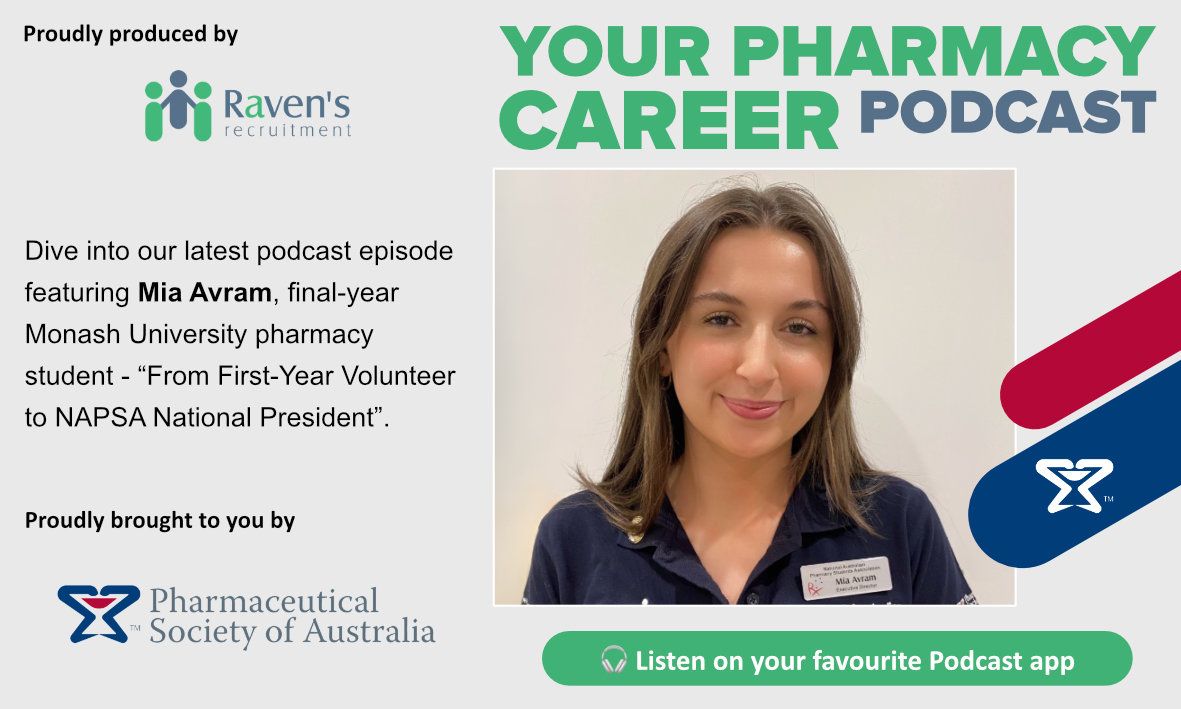
Podcast Recap: Mia Avram - From First-Year Volunteer to NAPSA National President
Welcome to this special recap of Your Pharmacy Career podcast, proudly produced by Raven’s Recruitment - Australia’s experts in pharmacy career and locum services for over 30 years.
What can happen when a first-year pharmacy student puts their hand up for something beyond the lecture theatre? For Mia Avram, that decision opened the door to national advocacy, organisational leadership and a much broader understanding of her future profession.
In this episode, host Krysti-Lee Patterson speaks with Mia about her journey from an uncertain school leaver to final-year Monash University pharmacy student and National President of the National Australian Pharmacy Students’ Association (NAPSA). Their conversation explores the value of early involvement, the responsibilities of leadership and why learning to say no can matter just as much as saying yes.
Episode Summary
Mia chose pharmacy for its combination of health, science and people, without initially realising the breadth of career opportunities available. Getting involved with NAPSA in her first year helped change that perspective.
Starting as Publications Chair, she progressed through policy and advocacy and treasury roles before becoming National President. Leadership was not her original goal; it grew from her enthusiasm for the work and commitment to supporting fellow students.
Mia reflects on NAPSA’s campaign for placement financial support, the value of student voices in decision-making and the confidence gained through advocacy. She also discusses balancing leadership with study, work and personal commitments, highlighting teamwork, delegation and succession planning.
As she prepares for an internship on Queensland’s Sunshine Coast, Mia looks forward to building patient relationships and experiencing expanded scope services firsthand. Her message is to embrace opportunities, seek support and recognise when it is appropriate to say no.
Key Takeaways from the Episode
An early opportunity can broaden your view of pharmacy. Mia’s first NAPSA role helped her discover career possibilities and professional connections beyond what she initially understood about the degree.
Leadership can develop through participation. Publications, advocacy and treasury responsibilities each built skills that later informed her approach to the presidency. There was no fixed leadership plan from the outset.
Student voices belong in decisions about the profession. Mia’s account of placement advocacy highlights the value of explaining students’ experiences and contributing to discussions that affect their education and future careers.
Organisational skills matter alongside clinical knowledge. Governance, financial oversight, communication and collaboration were significant parts of Mia’s learning through NAPSA.
Good succession planning supports the next team. Encouraging newer students to participate, documenting processes and maintaining useful resources help preserve knowledge when leadership changes.
Mentoring works both ways. Mia values the guidance pharmacists offer students, while recognising that students bring contemporary knowledge, fresh perspectives and ideas of their own.
Patient relationships remain central to her career ambitions. Despite her enthusiasm for advocacy and leadership, Mia is particularly excited about getting to know patients and contributing to their care through everyday practice.
Saying yes needs to be balanced with capacity. Her closing advice recognises both the opportunities that come from stepping forward and the importance of protecting time, wellbeing and other commitments.
Our Partners & Supporters
Pharmaceutical Society of Australia (PSA)
Proudly brought to you by the Pharmaceutical Society of Australia. The PSA is committed to empowering pharmacists through advocacy, innovation, and industry-leading professional development. To become a member or learn more about how the PSA can support your career, visit www.psa.org.au.
Pharmacy Daily
Pharmacy Daily is a proud supporter of Your Pharmacy Career Podcast. If you're in the pharmacy world, it's a great resource to stay up to date with the latest industry news. To subscribe, just head to pharmacydaily.com.au to get the newsletter delivered straight to your inbox.
📩 Enjoyed the episode? Subscribe, share, and leave a review to help others discover these valuable career insights!
Final Thoughts
Mia’s story shows how professional involvement can shape a pharmacy career before graduation. A first-year volunteer role became an opportunity to understand the profession, contribute to national conversations and support the students who would follow.
Her message also extends to established pharmacists. Offering a placement, starting a conversation or making time to mentor can help a student see possibilities they had not previously considered. As Mia explains, those relationships can be rewarding for both people.
The invitation is to consider an opportunity that fits your interests and circumstances, whether that means joining an association, supporting a colleague or reaching out for guidance.
What could putting your hand up, or helping someone else take that first step, make possible in your pharmacy career?
Full Episode Transcript
Narrator (00:01.058)
Welcome to Your Pharmacy Career Podcast, proudly produced by Raven's Recruitment, the experts in pharmacy career and locum services for over 30 years. Every episode is your gateway to new opportunities in the pharmacy profession, from expert advice to inspiring success stories. We're here to spark your pharmacy journey. Stay tuned. The next step in your pharmacy journey starts here.
Krysti-Lee Patterson (00:30.122)
Welcome to another episode of Your Pharmacy Career Podcast. My name is Krysti-Lee Patterson, and I am your host as usual. And today I am speaking with Mia Avram. She is a final-year pharmacy student at Monash University and the newly elected National President of the National Australian Pharmacy Students' Association, NAPSA.
Mia has been a part of NAPSA since her very first year of study and served as Treasurer before stepping into the top job earlier this year. So welcome, Mia, and welcome to the podcast.
Mia Avram (00:59.790)
Thank you for having me.
Krysti-Lee Patterson (01:00.696)
So Mia, to start, I would love to understand a little bit more about yourself and what drew you to pharmacy.
Mia Avram (01:09.964)
Yes, I always get this question, and I wish I had a bit more of an interesting story. But I was one of those students in high school who didn't really know what they wanted to do. And I was quite high-achieving at high school, and there was a lot of pressure for me to sort of, you know, pick something that was hard to get into.
And I also left it very last minute. So I wanted to pick something that was in health. Health has always been a passion of mine, and I saw pharmacy on paper.
And I had a family friend who studied pharmacy, or was a pharmacist as well. And I didn't really talk to them too much about it, but I sort of just decided to go for it, also because that way I could go on to study something else after if I chose to.
And yeah, I fell in love with it, basically. So I sort of picked it not really knowing 100% what a pharmacist does, but on paper I loved the biology and the chemistry and the people. And then only through sort of jumping into it and getting involved within the profession was when I realised, okay, yes, I picked the right thing.
Krysti-Lee Patterson (02:04.910)
Picked the right thing. That's great. I would love to understand, though, what you thought a pharmacist did before you started doing the degree. Like you said, you weren't really sure, but yeah, what was that concept in your mind at that time? And now that you're in your last year, has that view changed?
Mia Avram (02:25.964)
100% has changed. And I think I sometimes think back, what did I actually think a pharmacist was? Because I was very grateful I didn't have to go to the pharmacy very much when I was younger.
So I definitely only really thought community pharmacy was what pharmacists did. I didn't even know pharmacists could work in a hospital, let alone any of the other non-traditional areas.
And I think I thought that they were obviously the gatekeepers of medicines and did a lot of work with drug discovery and things like that. And I think that's also why I picked it, because I thought, you know, you can work with people, but you also can go off into that more research area if you want.
But yeah, I just thought they stood behind the counter and sort of gave people their medicines. Beyond that, I definitely didn't really know what I was getting myself into.
But now, I mean, I've only got a couple of months, if that, left of uni. And I was speaking to a friend the other day about the career paths in pharmacy, and there is so, so much you can do as a pharmacist, even outside of the health space. Like, there's so much.
So it's definitely been a really good pick that I sort of stumbled into. And I'm really grateful that, you know, I can change and jump between different areas so much in my career. And you're not really confined to one area, and that's it.
Krysti-Lee Patterson (03:41.118)
Absolutely. I think that's the biggest thing. And that was the big realisation that I had as well, going through uni and working in pharmacy and seeing all the different opportunities that were out there.
So you have actually been involved with NAPSA since your very first year. I was a pharmacy student that did not do anything with NAPSA, or I didn't also do anything with my pharmacy association at the uni either.
I started pharmacy at 21, so I was considered a mature-age student.
Mia Avram (04:15.202)
Which is crazy.
Krysti-Lee Patterson (04:11.394, continued)
So crazy. I don't know if there's anything mature about me at 21.
But now I see how incredibly important being involved in these organisations is, not just for your own development, but also just to see what else is out there.
Do you think that you maybe wouldn't have these same insights if you hadn't been involved in NAPSA since the start of your journey?
Mia Avram (04:41.762)
Yes, 100%. I started uni, obviously, at the start of the year in first year, and I didn't want to get involved with anything straight away, partially because I wanted to settle in. Obviously, school is very different to university life.
And so I spent the first six months of uni really just getting used to what uni is. But a lot of those first-year subjects are very foundational knowledge, so your bio and your chem.
And I think I felt a bit like I was missing something. And so when NAPSA opened elections for chair positions midway through my first year, I thought, why not give it a go? Why not try?
And that was sort of the catalyst for everything that's happened since. And I sort of broadened my horizons to what I was saying before about how much there is within the profession that you can be involved with.
Not long after that, we also started doing OSCEs at uni, and then I went on placement in second year.
So I think that being involved there and then sort of through uni, getting further through it and seeing all of those other things and really understanding what I would be doing in my career and what a pharmacist does was sort of, yeah, the start of everything that I've come to learn now and everyone that I know.
So yeah, I can't imagine having not put my hand up in that first year. And I think if I hadn't, life would look very, very different now, and probably not for the best.
Krysti-Lee Patterson (06:09.358)
Yes, I definitely agree with you there. I think you definitely got to see more of what's out there, start building your network as well early on, which is only going to help when you're going for your internship and getting jobs in the future as well.
But for those that are listening that maybe they're only first years, or maybe there are pharmacists that didn't have much to do with their student associations, could you just give a bit of an overview as to what actually NAPSA is and what their role is?
Mia Avram (06:42.380)
Yeah, so NAPSA is the peak body for Australian pharmacy students. We represent over five and a half thousand members across the country.
And we've got university associations at the 19 schools across the country that offer pharmacy, and they make up NAPSA, basically.
So we do a lot for our students. We sort of dip our feet into every aspect of pharmacy.
We run an annual conference every year, which has education and social events, and it's a really good opportunity to bring the students from every corner of the country together.
We run educational sessions throughout the year to complement learnings that our members have at university.
We also run an annual charity drive and blood drive as well. And we also run a National Pharmacy Student Survey every year, which is really, really important data.
And we share that and use that in our advocacy for students so that, I guess, the profession that they're entering knows what their needs are and what they want.
And at the end of the day, we are an advocacy body. We advocate for whatever's in the best interests of our members.
So that's just a short snippet of what we do. And we have a team of over 70 students nationally, alongside, obviously, all of those students who are involved in their local associations.
And those students are who will be our future leaders in the pharmacy profession as well.
So being involved with NAPSA is a great opportunity to learn those governance skills, what it's like working with a team, collaborating on not just your uni projects, but on a larger scale, which is a really, really valuable experience.
And not just me, but a lot of my peers and colleagues have sort of explained how impactful NAPSA has been on their career. And we've already seen some of our alumni go off and do incredible things after they graduate.
Krysti-Lee Patterson (08:29.710)
I just want to touch on an interesting point that you made around the role of NAPSA being advocacy, because I think the role of NAPSA has changed a lot from when I was a student and then also when it first started.
And I think in my mind, especially when I was a student, I didn't really understand that advocacy piece of it.
And I did finally join my local association when I was in fourth year because I wanted to have a say on where we went to the graduation ball.
But it's actually so much more than that, as you said.
And I think in particular, this year there's actually been some really important things that NAPSA has been involved in in regard to advocacy for pharmacy students.
Did you want to touch on a couple of those things? And the main one I'm thinking of is the student placements.
Mia Avram (09:24.172)
Yes, of course. I think you bring up a good point about being involved with advocacy.
I think, you know, even something as little as having a say in where the graduation ball is going to be held, that's still advocacy. You're still advocating for what you think is best.
And I definitely have grown to realise how important advocacy is, being involved in NAPSA.
We're entering a profession where a lot of the decisions that are made for pharmacists and for pharmacy aren't necessarily made by pharmacists.
So it's really important, realising early that our voice is so important. We need to be in the room where those discussions are being held.
Which ties really nicely into the recent announcement that the government made that we're expanding the Commonwealth Prac Payment to pharmacy and nine other allied health disciplines.
So NAPSA campaigned to have that expanded over the past sort of two to three years, which was a really big learning process for us as an organisation.
It's the first time we've ever had such a large-scale national campaign. And it was, you know, hard at times, that's for sure.
But at the end of the day, being in Adelaide not too long ago for the announcement was really, really rewarding.
And literally as soon as the announcement was made, we were already hearing from our members how excited and grateful they were for that news and the large role that not only NAPSA but the rest of the pharmacy profession as well played in making sure that that could happen.
So yeah, really, really exciting win for pharmacy students. And I think a really good lesson as well as to how valuable advocacy really is.
Krysti-Lee Patterson (10:59.598)
Absolutely. And just that your voice actually does matter.
I mean, as you said, decisions get made without pharmacists being involved, or decisions about placements get made without pharmacy students, or just any student, being involved.
So I think, yeah, achieving that is really huge, especially for someone that has tried to implement change alongside the PSA and the Guild when we were first looking at introducing immunisations.
We've got to speak to members of parliament and learn how to do that because you've got such a short period of time, and it's also a bit daunting speaking to politicians as well.
Mia Avram (11:37.910)
Yes, I definitely thought that at the start.
But one thing I can definitely take away from being so heavily involved in the campaign is that once you sort of get involved and you realise that everyone's a person at the end of the day, you know, it's not actually that hard.
And a lot of members of parliament join with the intention of helping people, and they want to serve their community, just like, I guess, pharmacists become pharmacists to serve their community.
And so a lot of it is actually just explaining what the issue is.
You know, there's so much going on in the world, and so often it's a matter of, hey, this is the problem, and making people aware of that, and then working with them to show how that can be fixed and how that can be changed.
And yes, always a bit scary talking to people that have the power to make those decisions.
But once you sort of realise that everyone's a person at the end of the day, it really is a lot easier, I think, than people think.
Krysti-Lee Patterson (12:31.224)
Great advice. And that's one of my things that I always try and reinstate, and also to instil in other pharmacy students as well, that people are just people.
Whether it's an MP or a future employer, at the end of the day, they're people.
So you are now the President of NAPSA, and you've got, as you said, around 70 people working alongside you, and then you're also representing almost 5,000, or maybe more than 5,000, pharmacy students.
Was becoming National President something that you were like, "Oh my gosh, I can't wait to be president. Like, I really want to do everything I can to get there"?
Or was it something that was a bit more of a surprise and you kind of fell into that role?
And I guess when you were coming after Seb, and Seb did a great job of leading the team, how did you, I guess, manage that progression of, okay, putting your hand up to actually be nominated?
Yeah, that can also be quite daunting because people have to vote for you, I believe.
And then once you became president, yeah, if you could maybe share some insights from your experiences so far.
Mia Avram (13:46.048)
Yeah. So I think it takes me back to first year when I first got involved with NAPSA, and that was as Publications Chair.
So running the social media, managing the website, definitely fed, I guess, a part of me that I wasn't getting in university in terms of a bit of a creative outlet.
And from there, that's when I never joined wanting necessarily to be president.
So that was step one, and I really, really enjoyed that.
And so once that term wrapped up, I applied to be on board as Policy and Advocacy Director. And I did that for another year.
And that was when, again, that sort of advocacy passion started to develop.
And I got to work, I guess, at that higher level with the rest of the board at that time.
And then there was an opportunity to step up to be Treasurer about six months into that.
So then I did both roles for six months as well, and then decided to continue with Treasurer because I absolutely loved, I guess, the learnings that I got from that.
I think that's sort of skills that you can't really develop anywhere else, being able to manage so much of the behind-the-scenes running of the organisation.
And then that's when I sort of was like, you know, NAPSA is such a fundamental part of my life now, and I actually don't think I can imagine a world in which, at least while I'm a university student, I'm not involved with the peak body for pharmacy students.
So yeah, then I thought, what's the natural next step? And that was being president.
And that was also really about having that organisational knowledge, having been involved for the three years before, and being able to mentor and teach first years and second years and people who are getting involved with NAPSA for the first time.
So I think for a lot of students, we sort of start by putting our hand up because it is really good for your own personal development and growth, whether it's learning new skills or, you know, having that on your resume to be able to show to people, hey, you know, I'm involved with these other things outside of my mandatory uni requirements.
But, you know, it didn't take long for that to really develop for me into sort of a sense of duty and passion, and a real sense of duty to serve, as you said, our over 5,000 members.
So it sort of felt like I had to, in the nicest way, in terms of being able to guide the rest of the team with the knowledge that I had built over a wide variety of areas across the association in the preceding three years.
And definitely taking over from Sebastian, I had very, very big shoes to fill.
But I was very confident, I guess, having worked with him so closely over those two years, that I would be able to continue that great work and also keep the momentum going with a lot of projects that, you know, don't necessarily wrap up when your time is done, and they go on over different generations of students.
So I felt, yeah, it's really important to keep that going.
As you said, NAPSA has come a long way, and we've been able to achieve so much in this recent sort of few years.
So definitely felt a bit of an obligation, but also it's an incredible honour as well to be able to represent everyone.
Narrator (16:49.630)
Pharmacy Daily is a proud supporter of Your Pharmacy Career Podcast. If you're in the pharmacy world, it's a great resource to stay up to date with the latest industry news.
Subscribe at pharmacydaily.com.au to get the newsletter delivered straight to your inbox.
Krysti-Lee Patterson (17:03.182)
Well, congratulations, if I haven't actually said that to you yet on the podcast. And I'm sure I've said it to you before in person.
So with your role as president, there's obviously some really great things that you're going to be learning about leadership and managing people, also understanding the dynamics of our pharmacy industry and getting involved in that way.
But I'm sure there's going to be times that maybe it might be a little bit stressful or challenging.
And so maybe if you could share with us some of the challenges or the learnings that you've had to overcome since coming into the presidency role.
You're almost at the end of it, really. Or is it calendar year, or is it...?
Mia Avram (17:47.498)
Yeah, I started in July, and I'll be here until next July. So halfway there or so.
Yeah, I mean, it's definitely not a walk in the park, but in the best way.
I think the challenges are what makes it so rewarding and what, I guess, has kept me around this long.
So yeah, I think the very obvious one is managing your time.
Not only am I a full-time university student, but I also work part-time. I have friends, other things I want to do on my weekends.
And so for me, it's definitely been a challenge at times to sort of have everything going on at the one time and make sure that nothing suffers.
So, you know, as much as sometimes NAPSA is where I really want to put my effort, and it's really fun or engaging for me to be in meetings or talk about new projects, sometimes I have to sort of consciously go, okay, no, you've done enough for one day.
Time to actually, you know, sit down and study for your test coming up next week.
Or, you know, when it comes to attending conferences or attending in-person events, managing that with university commitments is sometimes a bit of a challenge as well.
But I guess the learnings that I've got from that is to have a really supportive group around you.
And Monash has been incredible in that sense, in making sure that I'm able to do both.
And also the rest of the NAPSA team have been really helpful as well in terms of, you know, if there's something that needs to be done and I don't have the capacity, the team's really great in being able to take that off your shoulders.
And vice versa, if one of my board members isn't able to do something.
And I think that's what happens in the workplace and what happens in life, but sometimes, you know, you want to do it all or you feel a sense of responsibility, but sometimes it's about learning to sort of let go and let other people help where they can.
And yeah, I guess keep on top of everything. But sometimes you sort of just have to put your head into it and just smash it all out.
But with uni finishing up and me heading into my internship next year, I think I'll be sort of relearning all of that again and how to manage full-time work with being NAPSA President as well, which I've obviously got some good advice from people who've done that before.
But I think, as probably many people listening know, the transition from being a university student to full-time work, I've heard, is a bit of a fun one. So yeah, I'll see how I go.
Krysti-Lee Patterson (20:17.432)
I'm sure you'll do fine.
As you mentioned, you're already managing quite a bit on your plate already, especially being a full-time student, working as well part-time, doing NAPSA, and as you said, ensuring you're making the time to spend time with friends and family and doing the things that you love.
That's something that I certainly haven't really done well in my career.
I always tend to hyperfocus on a couple of things, and other things already fall behind.
So the fact that you're already realising this now puts you in good stead for the future in your internship.
So now that you're moving into your final year of university and you're about to embark on your internship, and not only are you doing your internship, but you'll also be doing your presidency, as you said.
What are some of the things that, I guess, you're thinking about what that next step is going to look like for you as a president?
So obviously your workload is going to change.
And when you think about 12 months, that's only quite a short period of time to try and get things done, especially when the election cycles for NAPSA are every 12 months.
How are you going to, I guess, prioritise and help bring the rest of the board and the rest of the team to achieve the things that you want to achieve and the board wants to achieve while you transition through that period of becoming an intern?
Mia Avram (21:40.908)
Yeah, I think it's a good question and something that I think comes with time as well.
NAPSA, as you said, has a lot of turnover. We are students for, I guess, a blip in time when you look at the grand scheme of things.
And so one of my, I guess, key focuses, and something that, you know, if you ever walk past me at uni or somewhere, I will encourage first years to get involved as soon as they possibly can.
And I think I was very grateful to be involved at such an early stage in my career.
And I think in some ways you're doing yourself a disservice if you wait and if you put it off.
I've had conversations with people who've been in their fourth year, like yourself, who've gotten involved then and sort of loved it so much, and then been, I guess, really disappointed that they can't continue because they've graduated and they're done.
And so I think getting involved in your first year is so, so incredibly rewarding because if you don't like it and it's not for you, then that's okay.
You can step back and you can continue on and maybe find something else.
But if you do love it, it means you've sort of given yourself that time to, you know, continue and work your way up the ladder and try new things within that and really make more of a difference.
So I'm trying really hard to get our early-year students involved as soon as possible because they'll be the ones who'll end up, you know, taking over from me in a year or two's time.
And I think that succession planning is so, so important in an association where we don't have years of experience in terms of how things go.
So that's number one.
And number two is just really reinforcing all of the wonderful systems we have in place.
It might seem boring, but those systems are, at the end of the day, what keeps us functioning and running smoothly.
So obviously people and teams after me can always call me or reach out if they have questions, but having the tools there and the resources there so that people are set up for success is really, really important.
And NAPSA has done an incredible job ensuring that that has been the case over the past few years.
But, you know, our profession's always changing and there's always new things happening.
So trying to keep on top of all of that and making sure everything's sort of, you know, our ducks are in a row, I think that's really important as I sort of get into the second half of my presidency and prepare to hand over the reins to someone else.
That team feels confident and capable of taking over and not sort of like they're stepping into the unknown.
Krysti-Lee Patterson (24:15.222)
Yeah, absolutely. I think succession planning is so important for committees, especially like NAPSA, as you said, because of that high turnover.
Like, I mean, I sit on the PSA branch, and a term is three years. So 12 months is not long.
So Mia, what are you most looking forward to as you transition into becoming an intern and then a pharmacist?
Mia Avram (24:39.320)
Good question. It's definitely crept up way quicker than I thought.
Sometimes I still feel like I only started studying the other day.
For me, I'm really excited to work. And I know that sounds perhaps a bit cliché, and I might regret saying that once I start.
But, you know, we spend all this time learning a wide range of knowledge when it comes to medicines and pharmacy.
And so something I'm really looking forward to is being able to immerse myself fully into that.
Obviously working part-time gives you a great insight into that, but being able to develop relationships and rapport with patients and being able to see them every day and know who they are and they know who you are is something that I'm really looking forward to, because, I mean, that's why I sort of fell in love with pharmacy, to be able to do that.
So I'm really looking forward to that.
And then obviously being an intern is all about learning as well.
So I'm really looking forward to learning what else there is outside of what I've learned at uni.
So I'm really grateful to be moving up to the Sunshine Coast at the end of the year and to do my internship in Queensland.
And I think with the expanding scope of practice, that'll be something that, whilst I do know a lot about and have learnt about at uni, I'll be able to see firsthand and delve a little bit deeper into what that looks like.
And that's something I'm very passionate about continuing and doing myself once I graduate and become a registered pharmacist too.
So that's a snippet. But as I said before, there's so much.
So I think that's step one, and then I'm very flexible and looking forward to seeing what sort of happens after that and where my career takes me.
Krysti-Lee Patterson (26:22.408)
How exciting. And I think, you know, moving into Queensland, not only is it a bit warmer than down south, but yeah, so it sounds like you'll be working in a place where there's people that are already doing some of the prescribing in full scope.
So that's amazing that you'll be able to see that firsthand.
Mia Avram (26:40.620)
Very much looking forward to that and being able to vaccinate myself and get involved with everything that being involved with NAPSA has taught me about the profession and, you know, I've been in conversations about.
But being able to actually be there and sort of witness it firsthand and see the impact that these services can have on Australian patients, I think will be really rewarding for me as well.
Krysti-Lee Patterson (27:05.526)
Absolutely.
Well, Mia, we've come to the end of the podcast, and so I just wanted to give you the opportunity.
Is there anything in particular that you want to get out to our listeners?
So some of our listeners are pharmacy students, some of them are interns, some are pharmacists.
But I'll leave it open to you for you to share any insights or comments, anything that comes to mind.
Mia Avram (27:29.250)
It's a good question, and I'm glad you mentioned it.
The other day I had a friend of my brother actually reach out who was a science student and sort of unsure about what career he wanted to do and was considering pharmacy.
And he reached out to have a chat about, you know, how I'm enjoying the degree and the profession.
And I think one thing that came out of that conversation that I had with him was that the pharmacy profession is unlike any other in terms of how supportive we are of each other.
I know so many pharmacists who are incredible mentors and so willing to support students, and so many students who are, you know, so supportive of their peers.
And so I think one, I guess, message, whether it's to someone considering pharmacy or whether you're already involved and perhaps you're thinking of becoming a preceptor or you're thinking of getting involved in, you know, a professional organisation where you're collaborating with other professionals, is say yes and do it.
Because I think it's such a special sentiment that we have within our profession.
And I can't think of any other profession that has such a strong support for the future generations.
And so yeah, I think, you know, whether it's mentor or student, put your hand up and reach out to someone.
You'll be very, very surprised by how many people are so supportive, or willing rather, to sort of say yes and help guide you.
And that's something I'm very grateful that I've been able to experience firsthand myself, and something that I'm also really excited that other people will be able to experience.
And I think it's a very strong reason why people should pick pharmacy.
Krysti-Lee Patterson (29:04.844)
Yes. And I think that's so important about pharmacists reaching out and being mentors or even just having conversations with students.
Or even if you're a pharmacy that hasn't taken pharmacy students on placements, even maybe start offering that. Reach out to the universities.
Because it's those people who you have interactions with early in your career that can really change the direction of where you go in pharmacy.
And so I was very lucky in my internship, actually, and my preceptor was amazing.
And she was the one that took me to APP, and I was like, this is amazing. I should have been involved since day one.
And there's been other people throughout the years where, even when I've been having maybe doubt or things, not just only when I was a student, but even as a pharmacist.
And yeah, by people reaching out to me and giving their tips and tricks, it's definitely helped me realise that this is definitely the best career.
Mia Avram (29:57.622)
Yeah. And it's also really rewarding for you as well.
Like, I walked out of that catch-up with that student who was considering pharmacy feeling really fulfilled and really happy.
I mean, I love talking about pharmacy. I do it all the time.
And so I think that was part of it as well.
But, you know, mentoring students, you know, we're fresh in university or just out of university, so there's so much that we can learn from each other as well, whether it's contemporary knowledge or new ways of doing things.
So it's definitely a reciprocal relationship, and I think one that is definitely very underrated.
And we're very, very lucky to have that so strongly embedded within our profession.
Krysti-Lee Patterson (30:37.110)
I love that.
Well, Mia, before we wrap up, I've got what I call the rapid-fire round, where I ask you five questions and just the first thought that pops into your mind, just say, whether it's one word or a sentence.
No pressure, no answer is incorrect.
And so the first question I have for you is coffee or tea?
Mia Avram (30:59.640)
Coffee.
Krysti-Lee Patterson (31:01.710)
True pharmacist.
Second question is, what's one word to describe the NAPSA conference?
Mia Avram (31:08.504)
Unforgettable.
Krysti-Lee Patterson (31:10.000)
Love that, love that. What's your favourite subject at university so far?
Mia Avram (31:15.094)
I would say professional practice.
I love, as much as I don't love OSCEs and being assessed, I love role-playing and actually working with real cases and a patient in front of you.
Krysti-Lee Patterson (31:26.774)
Second-last question. If you weren't studying pharmacy, what career would you be chasing?
Mia Avram (31:32.418)
That's really hard because I actually can't think of myself doing anything else.
But I would probably say something within... I might start that again because I genuinely don't know.
That's a really hard one because I genuinely can't think right now what else I would be doing.
But I mean, something else in health. Maybe I would love to look further into optometry or occupational therapy.
I don't think I could give up the health part of it, but pharmacy is definitely, definitely where I'd like to stay.
Krysti-Lee Patterson (32:06.778)
Well, that's good. It means you've made the right choice, right?
If it was too easy to answer that question, then maybe you're in the wrong field.
So the last question I have for you is, what's the best piece of advice you've been given, whether that's as a pharmacy student or just in life?
Mia Avram (32:21.954)
I think the best piece of advice I've been given is a bit of a... it goes both ways, but say yes, but don't always say yes.
I think the advice of say yes is really important because, you know, sometimes you doubt yourself and don't think an opportunity or experience is right for you.
And you should 100% say yes to everything that you can.
But at the same time, I think my peers and us as pharmacists are very keen to sort of say yes to everything and take on a lot, but I think it is a recipe for burnout sometimes.
So it's a fine line of sort of saying yes to things, but looking after yourself at the end of the day and making sure you don't feel obligated to say yes to everything.
And it is also okay to say no.
Krysti-Lee Patterson (33:03.814)
Yes. Perfect. I think that's the best way to end that.
So have the confidence to say yes, but also if it's not the right time, it's also totally okay to say no.
Well, Mia, thank you so much for your time on the podcast today.
It's been really interesting getting to know you a little bit more, the person behind the president.
And I'm really excited to see where you take the board and the rest of the team at NAPSA over the rest of your presidency.
And I wish you all the best, and I'm so excited to see what you do next.
Mia Avram (33:36.472)
Thank you so much.
Narrator (33:38.000)
Thanks for tuning in to Your Pharmacy Career Podcast, proudly sponsored by the Pharmaceutical Society of Australia.
The PSA is committed to empowering pharmacists through advocacy, innovation, and industry-leading professional development.
To become a member or learn more about how the PSA can support your career, visit www.psa.org.au.
Don't forget to subscribe, share this podcast with your colleagues, and join us next time as we continue to explore your pharmacy career.