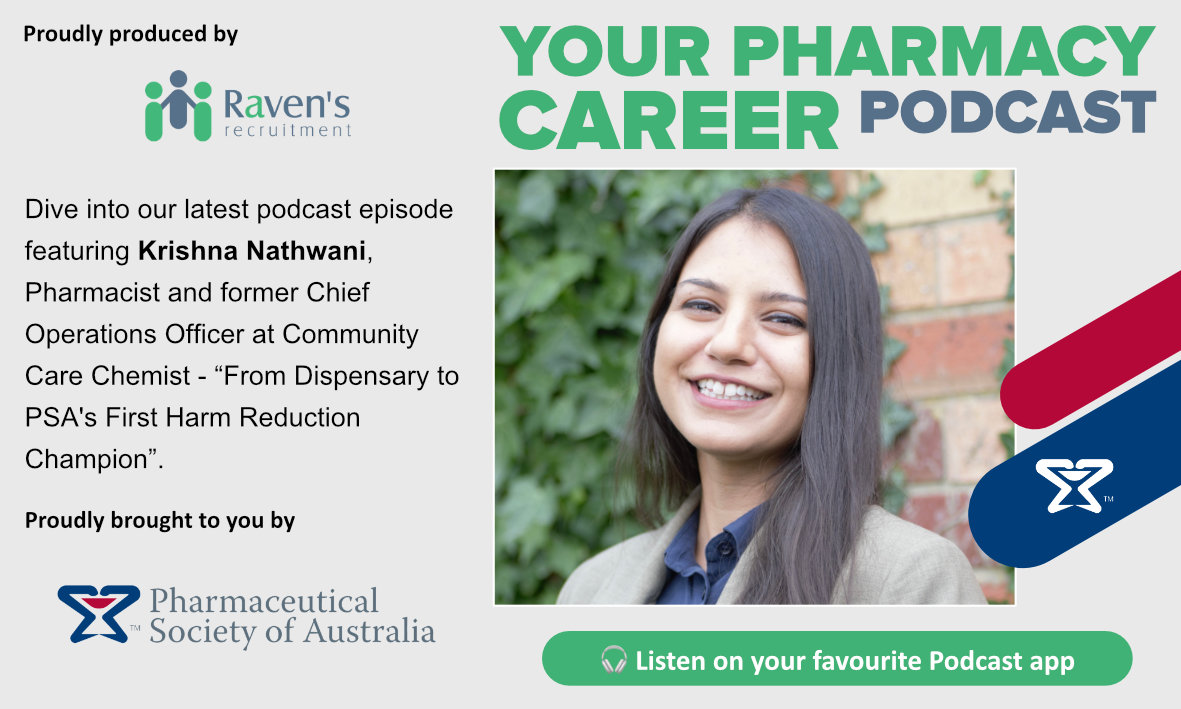
Podcast Recap: Krishna Nathwani - From Dispensary to PSA's First Harm Reduction Champion
Welcome to this special recap of Your Pharmacy Career podcast, proudly produced by Raven’s Recruitment - Australia’s experts in pharmacy career and locum services for over 30 years.
What does harm reduction really look like in community pharmacy? For Krishna “Krish” Nathwani, it starts with something deceptively simple - treating every person with dignity, meeting them where they are and making healthcare easier to access.
In this episode of Your Pharmacy Career Podcast, host Krysti-Lee Patterson speaks with Krish about her journey from community pharmacist and pharmacy manager to senior operational leadership, locum pharmacist and the Pharmaceutical Society of Australia’s inaugural Harm Reduction Champion.
Episode Summary
Krish’s pharmacy career has been shaped by curiosity, continuous improvement and a strong belief in equitable healthcare.
After registering as a pharmacist, she quickly stepped into pharmacy management before progressing through professional services and eventually into a Chief Operations Officer role with Community Care Chemist. Along the way, she became particularly passionate about developing health services, supporting pharmacy teams and building stronger connections between pharmacies, patients and the wider healthcare system.
Her approach to leadership was influenced long before pharmacy. Growing up in Tanzania, Krish watched her mother overcome significant challenges to establish an early childhood centre and create educational opportunities for her family. Together with the influence of her grandparents, those experiences helped shape Krish’s strong sense of community, equality and advocacy.
After completing an MBA and building extensive leadership experience, Krish made the difficult decision to step away from a secure senior role to pursue her growing passion for harm reduction. She returned to locum pharmacy, began expanding her advocacy and education work, and was subsequently appointed the Pharmaceutical Society of Australia’s first Harm Reduction Champion.
Throughout the conversation, Krish challenges the idea that harm reduction is limited to opioid pharmacotherapy or specialist services. Instead, she describes it as an approach to healthcare centred on reducing risk, removing barriers and meeting people where they are.
That can be as simple as changing the language used with patients, providing choice and privacy, knowing where to refer someone when a pharmacy cannot meet their needs, or making a “warm referral” by actively helping a patient connect with another service.
For Krish, one of the biggest opportunities is creating pharmacy environments where people accessing pharmacotherapy or other potentially stigmatised services receive the same respect, welcome and quality of care as every other patient.
Her priorities as PSA’s Harm Reduction Champion include destigmatised and trauma-informed care, improving rural and regional access, supporting pharmacies interested in introducing pharmacotherapy and other harm reduction services, and helping pharmacists recognise the difference they can make through relatively small changes in everyday practice.
Key Takeaways from the Episode
Harm reduction is broader than pharmacotherapy. It is about reducing risk, improving safety and helping people access healthcare without unnecessary barriers or judgement.
Dignity matters. The way patients are greeted, spoken to, counselled and accommodated within a pharmacy can significantly influence their healthcare experience.
Meet patients where they are. Effective healthcare does not always mean expecting someone to immediately change their behaviour. It can mean understanding their circumstances and helping make their next step safer and easier.
Separate clinical judgement from moral judgement. Pharmacists have a responsibility to exercise professional and clinical judgement, but personal judgement should not determine who deserves compassionate healthcare.
Small changes can have a meaningful impact. Pharmacists, interns and pharmacy students do not need to introduce an entirely new service to contribute to harm reduction. Reviewing language, improving privacy, providing appropriate supplies or identifying referral pathways can all make a difference.
Warm referrals improve access. Rather than simply telling a patient where else to go, contacting another service or pharmacy on their behalf can remove another barrier to care.
Leadership does not require a title. Krish believes pharmacists at every career stage can lead by identifying an issue, starting a conversation and helping their team explore a better way of doing things.
Career progression does not have to be linear. Stepping away from a senior executive role allowed Krish to reconnect with frontline pharmacy, experience different practice environments through locum work and create space for advocacy.
Start with curiosity. One of Krish’s strongest messages is to ask what the local community actually needs rather than assuming every pharmacy needs to offer every possible service.
Our Partners & Supporters
Pharmaceutical Society of Australia (PSA)
Proudly brought to you by the Pharmaceutical Society of Australia. The PSA is committed to empowering pharmacists through advocacy, innovation, and industry-leading professional development. To become a member or learn more about how the PSA can support your career, visit www.psa.org.au.
Pharmacy Daily
Pharmacy Daily is a proud supporter of Your Pharmacy Career Podcast. If you're in the pharmacy world, it's a great resource to stay up to date with the latest industry news. To subscribe, just head to pharmacydaily.com.au to get the newsletter delivered straight to your inbox.
📩 Enjoyed the episode? Subscribe, share, and leave a review to help others discover these valuable career insights!
Final Thoughts
Krish Nathwani’s career is a reminder that some of the most meaningful changes in pharmacy do not necessarily begin with a new service, technology or job title. They can begin with a conversation, a different choice of words or simply asking whether there is a better way to care for someone.
Her journey from the dispensary floor to operational leadership, locum pharmacy and PSA’s inaugural Harm Reduction Champion also demonstrates how diverse a pharmacy career can become when pharmacists remain curious and willing to pursue the areas of practice that matter most to them.
Perhaps the most practical message from the episode is also the simplest: start with one thing. Look at the needs of the community, consider where patients may encounter barriers and identify one change that could make accessing care easier, safer or more dignified.
For pharmacists considering their own next career step, Krish’s story also offers an important question: what could become possible if you created more space in your career for the work you genuinely care about?
Full Episode Transcript
Narrator (00:01)
Welcome to Your Pharmacy Career Podcast, proudly produced by Raven’s Recruitment, the experts in pharmacy career and locum services for over 30 years. Every episode is your gateway to new opportunities in the pharmacy profession. From expert advice to inspiring success stories, we're here to spark ideas, guide your career, and help you achieve your goals. Stay tuned. The next step in your pharmacy journey starts here.
Krysti-Lee Patterson (00:26)
Welcome to Your Pharmacy Career Podcast. I'm your host, as usual, Krysti-Lee Patterson, and today I'm joined by a pharmacist whose career has taken her from the dispensary floor to the national stage as the Pharmaceutical Society of Australia's very first Harm Reduction Champion, which is pretty cool.
She has built a long-acting injectable buprenorphine program inside a growing community pharmacy.
Krysti-Lee Patterson (00:54)
She also mentors pharmacists through Monash University, and she has recently stepped back from a Chief Operations Officer role to focus more on advocacy, locum work, and helping other pharmacies to do what she's done.
So please welcome Krishna Nathwani, or Krish as she prefers to be known.
Krishna Nathwani
Thank you so much, Krysti-Lee. It's such a pleasure to join you on your podcast today. Thank you.
Krysti-Lee Patterson (01:22)
Thank you so much for joining me today. I want to start right at the very beginning of your pharmacy story. And so my first question is: what first drew you to pharmacy?
Krishna Nathwani (01:34)
I definitely came into pharmacy without much of a plan or knowing where it would take me. It initially appealed to me as the combination of healthcare and people, and that's what drew me to pharmacy in the first place.
Krysti-Lee Patterson
Mm, okay. And so when you were at university and then you became a pharmacist, how long was it before you, I guess, got into a management position?
Krishna Nathwani (02:01)
So it was when I started working in pharmacy, and that was at Kew Pharmacy, when I really enjoyed the leadership side of things and the people side of things. So I was fortunate to, as soon as I registered, actually jump into a leadership position.
So I went quite quickly into management and just explored that curiosity and different pieces of leadership that, you know, ended up with positive impact and positive outcomes for the patients. That was quite fun.
Krysti-Lee Patterson (02:30)
I love how you say it was fun because I feel like, being so young and fresh as a registered pharmacist, I'm sure those first few years of running that pharmacy, surely there were probably some challenges that maybe weren't as fun.
Krishna Nathwani
I think I've naturally grown up as someone who, if I see inequity, if I see something that doesn't really work, I'm very self-motivated to try and correct it to the best of my ability and with the people around me.
Look, it's been interesting. It's definitely been interesting and I've appreciated every challenge I've had. But, you know, when you've got a bit of a goal in mind, or even that continuous improvement mindset where even if you fix little things or tweak little things, you can make such a big impact at the end of it.
Krishna Nathwani (03:26)
That's the part that I really enjoyed. So that got me through the challenges.
Krysti-Lee Patterson
So with that mindset of continuous improvement, I would say that that's probably not something that all pharmacists would necessarily have, especially when they first start in a management role.
So did you have any exposure to any leadership training beforehand? Because it seems like you had quite a good background and handling on, I guess, some great leadership styles before you were able to jump in.
Krishna Nathwani (03:53)
That's very kind of you to say, thank you. I definitely have just been really fortunate to learn on the job, but I will say I have grown up with leaders around me at home, in my community. I've grown up seeing people advocating for change and I've always admired and observed from the sidelines.
So as much as I never had formal training before I graduated and registered as a pharmacist, there have been plenty of opportunities thereafter.
One thing I will say, though, is that not everybody has to have that will to really be in a management position or grow in that kind of field.
Krishna Nathwani (04:24)
And you don't have to be a leader in your space. If you find something you're passionate about, or you care about it, even just giving it that attention to detail or discussing it with your team and bringing them along, around you and your patients, you can be a leader without having any titles at all.
Krysti-Lee Patterson (04:52)
Absolutely. Now, Krish, I'm going to ask you something that I know I should have asked you before I started recording. Do you mind if I ask you a little bit about your background with your mum?
Because when we were chatting over breakfast that day and you mentioned about your mum basically starting with a school, do you mind if I ask you about that? Is that okay?
Because I think that ties in as well with what you were mentioning about how you had exposure to leadership. So I want to tie that into that too. Is that okay?
Krishna Nathwani
That's fine, yeah. If you wanted to follow up with, like, who are these mysterious leaders, I can definitely tuck it into there.
Krysti-Lee Patterson (05:21)
Great. Okay. So it sounds like you had a lot of exposure to some really amazing people in your life before you became a pharmacist.
And I know we've chatted off the podcast before about some of those people. So I would love if you could share, I guess, who some of those people were.
Krishna Nathwani (05:47)
Absolutely. So I guess the main one I'll start with is my mother. So I have two brothers and, you know, the three of us, we lost our father at a very young age.
Mum wasn't educated, but she went and got herself a diploma in early childhood, and she actually started an early daycare centre in her uncle's garage. This is in East Africa. That's where we grew up, in beautiful Tanzania.
You know, we saw her building that into an institution that's put us through this incredible education, all three of us.
Krishna Nathwani (06:17)
You know, incredible tertiary education, boarding schools. We've been so fortunate and I guess we've always seen what believing in something and working hard for it looks like.
We're also really lucky to grow up in our grandparents' house, and they were just incredible, progressive people who, again, believed in treating everybody equally, giving back and, you know, looking after your community.
So I think they're probably my... there's so many amazing people that I could...
Krysti-Lee Patterson (06:46)
Well, that's an amazing story. And I'm sorry that you lost your dad when you were so young, but it just sounds like your mum is such an amazing person. Like, to do that, to raise three kids and create something that she was so passionate about.
And it's so obvious to me seeing how community and passion are definitely some values that I can see through you, even just when I chat to you. I can see that.
Krishna Nathwani
I'm glad they rubbed off on me.
Krysti-Lee Patterson (07:14)
I think that's definitely helped shape who you are, and it's probably impacted why you're doing so much advocacy, especially in the harm reduction space, which I will ask you about in a minute.
But before we talk about that, I want to chat to you about what it was like leading the operations across the Community Care Chemist group. So for those that maybe aren't aware of the group, just give a little bit of background of the group and your role.
Krishna Nathwani (08:11)
Absolutely. So Community Care Chemist is one of the very few friendly societies remaining in Australia, where it's actually a not-for-profit organisation.
It's not owner-operated, but you have executives and a board of directors that manage, or that govern, the stores. And then on the ground, we have incredible teams and managers who lead the pharmacies individually as well.
So I joined as a pharmacist manager for one of the stores and was really fortunate to, again, right time, right opportunity, move into professional services and then the operations role.
Krishna Nathwani (08:40)
Throughout that journey, I really, really enjoyed service development.
I think service development, connecting different parts of the community that weren't very connected before, and then, you know, seeing how that can create a whole system. I guess that led to systems thinking, and then workforce was another part that was really special to me.
So making sure that our teams were looked after, that they were trained, that they were well supported. That's something that I found I was really passionate about.
Krishna Nathwani (09:00)
So I invested a lot of my time in capability development as well.
And there was quite a lot involved, I suppose. There's the management of the six pharmacies, training and development, there's the suppliers, there's... no, not legal. There's technological and software projects. There's developing new health services.
It was a very, very diverse role and I really enjoyed every part of it. Except maybe HR.
Krysti-Lee Patterson (09:59)
But Krish, I think hearing your story, how you got into that operations role, like starting out as the pharmacy manager in the pharmacy and then working your way up in professional services, that makes sense. You like building services and then moving to that more operations role.
You talked about training and development and upskilling. What did you do yourself personally, I guess, to either help you get to that point of getting that role, or when you were in that role, did you see any gaps where you needed to maybe look at some other type of education or training to help you?
Krishna Nathwani (10:55)
I definitely needed training to help me. And this is something that I learned from, you know, I had really good mentors when I started out there, and often the training opportunities would come from them saying...
But a part of it was also being open to it and accepting that this is an area you need development in.
Because I like to go, go, go. If I believe in something, I want to do something. I've been fortunate to have people who say, "Actually, have a think about this area over here. Go take this training course. Go do time management..."
Krishna Nathwani (11:23)
A time management program to make sure you aren't burning out.
So I've had great leadership and I've gotten to learn from great leadership who have invested that time in me.
And I guess that's one reason why also then, you know, including education and how hard my mother worked to give me all the opportunities I've had, I guess I just wanted to pay it forward and do the same for those under my care as well.
And that also takes a lot of just conversation, spending time, understanding motivations, understanding gaps. Yeah.
Krysti-Lee Patterson (11:52)
Exactly. Now I know that you were undergoing an MBA. Are you finished your MBA?
Krishna Nathwani
Yes. Just a few weeks ago. It feels like minutes.
Krysti-Lee Patterson
It does feel like minutes.
Krishna Nathwani
Funny story, it was actually my very last exam the afternoon that I flew in and out of the PSA conference to accept my Harm Reduction Champion role.
Krysti-Lee Patterson (12:15)
Oh wow. That's good dedication.
Krishna Nathwani
Phenomenal timing. Just made it to the final exam.
Krysti-Lee Patterson
Well, congratulations on getting through it. It's not an easy feat. As someone who's also gone through the MBA journey, yeah, it's nothing like the pharmacy degree. It's a lot.
Krishna Nathwani
Invaluable. So many parts of it that probably should be, from a pharmacy perspective. But yeah, no regrets whatsoever, I'm sure on your end as well.
Krysti-Lee Patterson (12:44)
Absolutely. And no regrets. It took me five years to do it, so I did a lot of other things in between.
Krishna Nathwani
Yeah, yeah. But I think that also just shows that, yeah, you can do it on your own terms as well.
Krysti-Lee Patterson
Yes. At whatever pace is suitable.
Krishna Nathwani
Exactly. That's it.
Krysti-Lee Patterson (13:14)
Now, this is probably a good segue into asking you about the harm reduction role.
So you have been, I guess, awarded with the inaugural role of being the Harm Reduction Champion for the Pharmaceutical Society of Australia. Perhaps you could maybe talk us through what led you to getting to the point where you wanted to be a part of this role, and then we can talk about what you're going to do with the role, if that's okay.
Krishna Nathwani (13:42)
Yeah, absolutely. Absolutely. So, not sure how to answer this question, but I'm just going to give it a go.
So I made the decision to leave my beloved COO role with Community Care and, you know, my beloved patients and team because I really, really wanted to just... I really wanted to follow my passion.
I was doing a little bit of consulting work in the harm reduction space. I was doing a bit of education. I was delivering education for health professionals.
And there was just so much opportunity and such a gap there in collaborative care and just bringing patients in. And there's so many great people doing such great things out there.
Krishna Nathwani (14:38)
And I just wanted to create space.
So it was a really, really tough decision because it's the first time I also had left a role without something else lined up.
Krysti-Lee Patterson
That is so scary.
Krishna Nathwani
Yeah, it was really scary. But the other thing that I wanted to do - Community Care was the second place, excluding my work as a pharmacy student, it was the second place I'd worked in as a pharmacist.
Krishna Nathwani (15:04)
And what incredible opportunities I had there. But I wanted to see what other jurisdictions were like, what other challenges were being experienced, how other pharmacies do different things.
So I thought I would locum, and I was really excited. And I am still really excited to be locuming and experiencing that firsthand and, you know, seeing how different pharmacists approach harm reduction as well.
That's something I subliminally wanted to just go and insert my experience from Community Care into other pharmacies.
So I left with just a couple of days of locuming booked, and that's it. And the rest have very quickly filled up, including this role that I'm very, very grateful to have received.
Krysti-Lee Patterson (15:34)
Yeah, well done. And yeah, leaving a very safe job that you also really like, it's very hard. It's no easy feat.
But I think, too, through your time at Community Care as well, though, you did do some work with harm reduction and long-acting injectable buprenorphine anyway. So this was something that you had already been kind of doing as well. So that makes sense.
So with this role as the Harm Reduction Champion, perhaps maybe you can talk first on what actually is harm reduction.
Krysti-Lee Patterson (16:28)
Because I think all of us probably have our own idea of what that is. Some people might not even know what that is. People might think that it means opioid substitution therapy, but it's so much more than that.
So I'd love to hear from your perspective: what is harm reduction?
Krishna Nathwani (16:53)
Definitely. That's a really good point, and we'd all have different definitions.
From my perspective, harm reduction is very much about making things really safe for people. We all make choices. Some may be good for us and others not. And this is the case from our diet to exercise, sleep.
Krysti-Lee Patterson
Yes.
Krishna Nathwani
You know, whether or not you take your blood pressure pills, or it could be anything.
So for me, harm reduction is a lot more than pharmacotherapy. That's one small part of it.
Krishna Nathwani (17:20)
But I think it's just accepting that everybody's on a different journey and it's just meeting them where they're at and doing the best that we can to prevent harm or reduce risk as well.
So another example, the first example that, you know, everybody can do without having to start a new service, for example, is looking at the way we talk to people. Just being destigmatising is harm reduction.
Krishna Nathwani (17:47)
Just creating that space for somebody to be able to access compassionate healthcare. That's harm reduction. Building that system where people can just come and ask questions, that's harm reduction as well.
So it starts from there and it encompasses a lot of things more broadly.
Krysti-Lee Patterson (18:08)
I like that. And while you were chatting, I thought, do you know what? Why don't I pop this into AI and see what AI says and what you said?
Krishna Nathwani
What did it come up with?
Krysti-Lee Patterson
And so I have just put it into Claude, who is my preferred AI tool. And it says - I'm going to paraphrase that - harm reduction is an approach to drug use and other risky behaviours that focuses on reducing the negative consequences of those behaviours rather than requiring abstinence as the only acceptable goal.
Krysti-Lee Patterson (18:35)
And it says it's grounded in the idea of meeting people where they are, treating them with dignity, regardless of whether they're ready or able to stop, and prioritising practical safety over judgement.
It goes on to talk a lot more, but I just thought that was really interesting because you actually said meeting people where they're at.
Krishna Nathwani
Yeah.
Krysti-Lee Patterson
Which is very important.
Krishna Nathwani
The only thing that I will say to Claude is that it's not just to do with risky behaviours and maybe drug use, but it's actually a lot more broad and applies to all things.
Krysti-Lee Patterson (19:03)
Well, there we go. Well, maybe we need to do some advocacy to AI.
Krishna Nathwani
But I love that. Dignity is something that is really important to me.
Can I talk about another organisation? I'm glad that Claude mentioned dignity because that was one of the core values of this organisation that we worked quite closely with.
It's called Give Where You Live Foundation. It's like a seed organisation, so it funds and supports other things like domestic violence and sexual health services.
Krishna Nathwani (19:52)
And we were very lucky in Community Care to work closely with them. I actually brought that into my LAIB clinics as well as a way that we can broaden our wraparound services and care.
But yeah, dignity was something that was so crucial to them in every aspect of what they did. Definitely agree with Claude there.
Krysti-Lee Patterson
Pharmacy Daily is a proud supporter of Your Pharmacy Career Podcast. If you're in the pharmacy world, it's a great resource to stay up to date with the latest industry news. To subscribe, just head to pharmacydaily.com.au to get the newsletter delivered straight to your inbox.
Krysti-Lee Patterson (20:18)
That's good to say. I was about to say "she". I don't know if Claude says she or he.
Krishna Nathwani
Depends on who they're talking to, I guess.
Krysti-Lee Patterson
Yes. Yeah. But I think, yeah, Claude has definitely got some good points there.
So I guess from your perspective, Krish, you're the first person to be this Harm Reduction Champion. But what does this role mean to you?
Krysti-Lee Patterson (21:05)
Being the first one, I guess you can start from a blank slate. There's no comparisons to anyone before you.
So I think that's probably a good thing, but it could also be maybe a bit of a scary thing as well because no one's done it before. So what does that mean? What do you do?
So maybe you could share what your initial thoughts are on what this role is and what it means to you.
Krishna Nathwani (21:31)
Absolutely. I had nothing but ideas on ideas on ideas.
Even as I was leaving Community Care, I was fortunate to, I guess, have the time to reflect. I was very grateful to have the capacity to reflect on what harm reduction needs from my understanding, and what gaps there were in my understanding that I still needed to understand.
So, gaps in my understanding, period.
Krishna Nathwani (22:01)
So with that, when I was honoured with this role, what I did was just continue a huge brain dump of all the ideas, all the challenges, everything that I had, and then try and organise it into, you know, priority areas like rural access.
Because it was not very coherent, and there's so many things that I wanted to tackle and that I wanted to help other people tackle as well.
I thought, yep, the best way to do it was throw it all down and then sort it afterwards. And, you know, alongside the PSA, we came up with priority areas for that as well.
Krishna Nathwani (22:31)
So trauma-informed and destigmatised education and care was a big part of that. Rural access, rural and regional access, was a big part of that.
We've got - I don't have the list here in front of me - but we managed to create about eight different priority areas and different ways to support each of those as well.
Yeah. The other thing that I'm very conscious of is that, you know, the PSA has created this exceptional space and platform for people to do these incredible things.
We look at the Vaccination Ambassador, and we've got two incredible Vaccination Ambassadors this year. This role is meant to be carried forward.
Krishna Nathwani (23:26)
So I'm very conscious that it might only be bits of each of those priority areas that get actioned, but even that means a lot to, you know, one person's care or to one pharmacy team.
So one thing, as an example, for rural access to pharmacotherapy services: if there are pharmacies that don't have pharmacotherapy services and want to, rather than trying to tackle it all, I'd really like to help maybe six or nine pharmacies establish services, you know.
Krishna Nathwani (23:56)
So for each of those areas, it might just be putting a cap on how much is possible and then going from there. But if more is possible, I'm here for it.
Krysti-Lee Patterson
Absolutely. Aim high.
And I think that's actually maybe a really simple way to start too, is, yeah, if there's people out there that want to start offering these types of services, or maybe they don't even know what services to provide, they can reach out to you and you can help guide them with that.
Krishna Nathwani
Yeah, definitely.
Krysti-Lee Patterson (24:25)
So you mentioned just a little bit before that one of the priority areas, or areas that you want to focus on, is destigmatising care.
And this is probably a question without notice, but what does that mean? Destigmatising care?
I was going to say, in your mind, what does that look like to you, especially in this role? Like, what do you hope to achieve?
Krishna Nathwani (24:46)
This is probably what I envisaged the hardest thing to achieve to be. However, I actually think it's the simplest.
And in my mind, it's treating everyone the same as they walk in the door. If they're your regular customers, knowing them by name, whether they're there for their pharmacotherapy dose or other services or just a prescription, asking how their day was.
From a workflow perspective, I feel like destigmatising care looks like a patient walking in and experiencing the pharmacy in the same way, no matter what they're there for, from where they come in and are greeted to where they have to sit and wait.
Krishna Nathwani (25:14)
They're not isolated. They're not, you know, cornered into an area. I've heard some horror stories, which I probably won't get into now.
Can I bring up a horror story? No. Can I?
Krysti-Lee Patterson
I think it would be completely okay. Because I feel like it's a good thing for people to maybe hear what good and not so good looks like, right?
And so I think it's good to share experiences because then people can learn from that.
Krishna Nathwani (25:43)
Yeah. The way that people come in and experience the pharmacy... I've heard some horror stories.
For example, there's one pharmacy - this is a what not to do - there is a pharmacy that I've heard of that has a red light, green light system, where there are two hours around lunchtime where the light will go from red to green, and that's when, first come, first served, pharmacotherapy patients are permitted to walk into the pharmacy, get their dose and go out via another door.
Krishna Nathwani (26:12)
And when the light is red, done for the day. You can't come in. You can't come in through the normal entrance.
That, to me, is the crux of what we shouldn't be doing as healthcare providers.
Krysti-Lee Patterson (26:38)
Yeah. That's really troubling for me, actually.
And I'm sure, too, that we don't want to judge anybody, even the pharmacy. Maybe they did that, their intentions might have been good in the beginning, maybe to increase efficiencies, and it could be to streamline things.
It might not have necessarily been a stigma thing, but that's not putting the patient at the centre.
Krishna Nathwani
It could be. No, you're absolutely right. It could be a resourcing gap, right? Maybe they're prioritising the way that their roster is laid out.
And that's without judgement. I actually have a lot of curiosity as to how, yes, how can they actually restructure things to make it work for everybody?
Krishna Nathwani (27:32)
Because I know when you think about things in lots of different ways, you can come up with a solution. When you bring more people into what that solution could look like, including your patients, it could be even better.
So I definitely think there's opportunity, and those are the conversations that I would love to have as well.
Krysti-Lee Patterson (28:02)
Absolutely. I think that's great. And it's good to share what all different types of services and things look like, whether it's best practice or areas that could be improved upon.
Because I think about some of the different pharmacies I've worked in over my time, and one that really stuck out to me, I guess, from a best-practice perspective, was that they didn't have a methadone window or anything like that.
They just did it in the consult room. So people would come in, they'd get called into the consult room and no one would know if they were getting their blood pressure done, a vaccine, or having a dose.
Krysti-Lee Patterson (28:30)
And I loved that when I first saw that. I was like, wow, this makes so much sense.
And I remember questioning the owner at the time, and I said, like, why do you do that? Like, shouldn't we, like, for safety? Right?
And he said, "Well, the people that are accepted into community pharmacy on these programs have proven that they can do this in the community, and they are wanting to maybe get their life back on track."
Or maybe perhaps it was something where it was no fault of their own, and he gave the example of one of our patients who just had a back injury going skiing and then ended up on opioids, and it kind of went down from there.
Krysti-Lee Patterson (29:00)
So it wasn't that this person was doing anything bad, and that kind of really opened my eyes.
And he said, "Why should we treat them any differently to someone that has diabetes?"
Krishna Nathwani
I agree.
Krysti-Lee Patterson
And I'm like, wow. It's not necessarily a choice because even, too, people with diabetes also sometimes get stigmatised around maybe they just need to eat better.
Krishna Nathwani
Yeah.
Krysti-Lee Patterson
Or go for more walks. So, you know, it happens. It is a health condition. If people are coming in and they are suffering from addiction, it is a medical condition. It's physiological. We're treating it.
Krishna Nathwani (29:54)
And, you know, the difference between clinical and moral judgement is something I go on about a lot. But that's exactly it.
We need to apply clinical judgement. That's our job. It's our duty of care. Moral judgement and deciding who gets that care is not quite... deciding who gets our care is not okay.
Krysti-Lee Patterson
Exactly. No, I agree.
And then I've also worked at some other ones where they have, like, a bit of a window that they can dose from.
Krysti-Lee Patterson (30:23)
Now in my practice, if I am doing any dosing, I like to ask them what they would prefer.
Some of them are quite happy to just, like, "Yeah, just give me the drink at the window," have a drink, and it just looks like they're having some water, and off they go.
But then others are like, "Can I actually come into the room?"
I'm like, "Yeah, of course."
Like, "Yeah, I don't really want people to see."
So I ask them what they would prefer, and I think that's really nice, giving them choice as well.
Krishna Nathwani
Agreed. Yeah, giving them choice.
Krysti-Lee Patterson (30:53)
Hit the nail on the head there. And that's Claude's dignity piece as well.
Krishna Nathwani
Exactly. That's right.
Can I just mention as well, there's the reward that comes from seeing a patient access that choice that we give them and, you know, change their lives with it, and to be a part of that journey.
Krysti-Lee Patterson (31:15)
It's also the most rewarding thing that I've ever had in my career.
Krishna Nathwani
Pretty cool.
Krysti-Lee Patterson
That's really nice. That's very special.
So, Krish, for people that are listening to this, what is probably one thing that you would like them to get out of understanding harm reduction and potentially maybe one thing that they could do tomorrow in their practice?
So, for example, some people that are listening, they might be a pharmacy student, so they can't implement a new service.
Krysti-Lee Patterson (31:45)
Or maybe they are working in a pharmacy that does have some practices that may be less than ideal. What would you say to them?
Krishna Nathwani
That's a really good question. Thank you, Krysti-Lee.
I would say start by being curious. And harm reduction doesn't mean that every pharmacy has to do everything. But really it's about: what's the need in the community? What do my patients need? What's going on? What could people use our help with as practitioners?
And then just starting with one thing.
If they're a pharmacy student working at a pharmacy, or an intern or a pharmacist and not the owner or a manager, and they don't directly decide which services are included, maybe try a pilot.
Krishna Nathwani (32:13)
Maybe just, you know, ask around and ask the rest of the team, "What do you think about this? What about doing the take-home naloxone program?", which is free for patients and really easy to sign up to as well.
Just think about what the barriers are to your patients accessing care.
Back to the, you know, language being destigmatising. Again, look at that. Just observe how everybody interacts with different patients. Is there something maybe you could improve?
Maybe there will be more people walking in to access care if they feel comfortable doing so, more comfortable doing so.
Krishna Nathwani (33:10)
There are some really great resources, like Language Matters is one, Power of Words is another one, that are readily available online, and they've got really easy switches for a lot of things that we don't even realise we're saying.
So I think talking about that as a team or looking at those resources as a team goes a really long way.
And then, yeah, just one step at a time and reach out.
Krysti-Lee Patterson (33:39)
One thing I was just thinking of, thinking differently about harm reduction, is just giving patients a sharps container if they are on injectable medications.
Like, it doesn't have to be about the needle and syringe program or harm minimisation, right? Minimising needlestick injuries in the home.
A lot of people are on Mounjaro and Wegovy and all that stuff. Same thing with peptides right now.
Krishna Nathwani
Yes, yes. Pharmacies are the best place to really improve and reduce harm in that area. Needle and syringe programs.
Krysti-Lee Patterson (34:07)
Exactly. That's right.
And you mentioned horror stories before, and I just have one that I'm keen to share, which is why I mentioned that.
But they actually didn't hand out any sort of syringes or needles. And I remember there was a script for Mounjaro, and this was before the pre-filled pens. It was when there was still the vial.
And I asked the assistant, "Where can I get the syringes from so I can show them how to use this new medication?"
Like, "No, we don't sell them."
And I'm like, "What do you mean?"
Krysti-Lee Patterson (35:02)
But no, we don't. In her words, she's like, "No, we don't promote drug use," or something.
And I said, "But this is actually not about that. How are they meant to use Mounjaro?"
And they're like, "You'll just have to tell them to go down the road to the other pharmacy."
And I just thought, what? This is insane.
And yeah, I just thought you've really got to think about things a little bit differently. Like, you can't just stigmatise.
But I just thought, well, harm reduction.
And the patient said to me, "Well, how am I supposed to use this?"
And I said, "I'm so sorry, but..."
Krysti-Lee Patterson (35:31)
When you're a locum, you can say, "I'm just a locum."
But I said, "There's another pharmacy down the road. I'll give them a call and let them know that you're coming," so that you don't have to walk in asking for needles.
So that was something that I tried to turn a, like, I guess a negative experience for that person into a positive.
Krishna Nathwani
Can I just say, that is harm reduction in practice. That is a prime example.
Because if that pharmacy you're at doesn't offer a particular service or what the patient needs, if you know where to send them and you do that, that's also... it's just making the next step easier and the next step easier.
Krysti-Lee Patterson
Because I just thought, because the area where this pharmacy was, was in, I guess, an area that was known to be not safe.
Krishna Nathwani
Not a safe area.
Krysti-Lee Patterson
So I could understand the reasons behind it, but then I didn't want that patient to then feel attacked again going into another pharmacy and then asking and being questioned.
So I thought, well, if I can minimise this, like, maybe that person will come back to this pharmacy because we found...
Krishna Nathwani (36:28)
I love that. That's another thing that you did that I love, and I call a warm referral.
It's when you don't just say, "Go here, call this number." You actually do that phone call with them there.
And, you know, it does, for somebody who's already experiencing... But in this case, it might not have been someone experiencing addiction, but at the same time it was someone who has a medical condition, is trying to navigate their healthcare.
We have a lot more health literacy than everybody in the community who has not gone to pharmacy school for years and years.
So that's, yeah, a really great example.
Krysti-Lee Patterson (36:58)
I didn't even know at the time it was harm reduction. So I'm learning something here now.
And that's something for everybody to take away as well, like knowing where to send somebody and guiding them and being that in-between person that connects the right person to the right service.
Krishna Nathwani
Absolutely.
Krysti-Lee Patterson (37:27)
Now, Krish, we're coming to the end of the podcast, which is a bit sad. But before we finish up, I've got some quick rapid-fire questions, which is just a bit of fun.
So if you just think of the first thing that comes to mind, don't overthink it. I've got five questions.
So are you ready for the rapid fire?
So the first one, to warm you up: coffee or tea?
Krishna Nathwani
Coffee.
Krysti-Lee Patterson
Number two: what is the best piece of advice you've ever been given?
Krishna Nathwani
There are a few contenders. Just the first one that came to mind, though, is: don't ask for permission. You can apologise later.
Krysti-Lee Patterson (38:20)
Yes, I love this. This is one of my favourites as well, and definitely one of my mantras.
Krishna Nathwani
I apologise to anyone that I've had to apologise to.
I've appreciated this advice because this is one of my bosses from Warrnambool, actually. And every time I wanted to do a new service or, you know, if it was legal, I would just over-ask and, yeah, he told me to do it.
Krysti-Lee Patterson (38:46)
Just do it. If it works, that's great. If it doesn't, you can apologise.
So good. Love it. I love it.
Question number three: what is one word to describe community pharmacy right now?
Krishna Nathwani
There's too many. Access is the first one that comes to my mind.
Krysti-Lee Patterson
Okay, yep. Well, that makes sense, especially with what you're doing around that harm reduction space.
Krishna Nathwani
Also, just in terms of - I meant it more in terms of us being so easily accessible to our entire community.
Krysti-Lee Patterson (39:16)
From that perspective, yeah.
Question number four: what's your favourite part of being a locum?
Krishna Nathwani
Meeting people.
Krysti-Lee Patterson
Meeting people, yeah. I like that.
And number five, last question: if you could change one thing about the profession overnight, what would it be?
Krishna Nathwani
It would definitely be the dignity and the destigmatised care across the board. Hands down.
Krysti-Lee Patterson (39:43)
Well, it makes complete sense with what you're doing in your role. I'd be shocked if it was anything different.
So Krish, thank you. This has been a really good conversation. It's been quite fun as well. It's nice to get to know you a little bit more.
But before we wrap up, is there anything that you want to share with our listeners that maybe we haven't touched on yet?
Krishna Nathwani
I just want to encourage everyone to not feel shy to ask questions of their peers, of support lines available, of champions and ambassadors, local or national.
Because the more we ask, the more we find out.
Krishna Nathwani (40:11)
And it's okay to meet a closed door because you'll find one that will open, basically.
But just, yeah, don't ask for permission. If you believe in something and you care about it, go do it and make it happen.
Krysti-Lee Patterson (40:34)
I love that. Well, thank you, Krish.
Well, if you'd like to keep following Krishna's work, you can find her on LinkedIn. You can also find her on Instagram.
What is your Instagram that people can reach out to you on?
Krishna Nathwani
The Harm Reduction Edit. And I would love for people to follow along on it and ask questions there. I can't wait to connect with everyone.
Krysti-Lee Patterson
Lovely. Well, we'll put both the links in the show notes, along with any details, so if there's any pharmacies out there wanting to build their own harm reduction services, they can reach out to you.
Krishna Nathwani
Thank you. And thank you so much for having me. I didn't quite grasp the concept of rapid fire, but it's been so incredible talking to you.
Krysti-Lee Patterson (41:02)
Amazing, thank you. Well, thanks again for listening to Your Pharmacy Career Podcast, and we'll see you next time.
Narrator (41:29)
Thanks for tuning in to Your Pharmacy Career Podcast, proudly sponsored by the Pharmaceutical Society of Australia.
The PSA is committed to empowering pharmacists through advocacy, innovation, and industry-leading professional development. To become a member or learn more about how the PSA can support your career, visit www.psa.org.au.
Don't forget to subscribe, share this podcast with your colleagues, and join us next time as we continue to explore your pharmacy career journey.